i've been collecting these for a few months and thought i'de share. i'm sure all of you are doing these but just in case.
1. A client has just joined a health care maintenance organization (HMO) and asks for information about the payment obligations with this plan. The most accurate description of health care costs is that the client will be charged in which manner?
1. Only for services provided by specialists
2. One flat rate for each service rendered
3. A pre-determined fee for all services *
4. The usual and customary fee for services
(12-2-08)
2. A nurse, assisting in the application of a plaster cast for a client with a broken arm, should understand which action is a priority
1. the cast material should be dipped several times into warm water
2. the cast should be uncovered until it dries
3. the wet cast should be handled with the palms of hands for 48 to 72 hours *
4. the casted extremity should be placed on a supporting surface
(12-8-08)
3. A nurse detects blood-tinged fluid leaking from the nose and ears of a client diagnosed with head trauma. What is the appropriate nursing action?
1. pack the nose and ears with sterile gauze
2. put manual pressure on the draining sites
3. apply bulky, loose sterile dressing to the nose and ears *
4. position an ice pack to the back of the neck
(12-15-08)
4. To prevent keratitis in an unconscious client, a nurse should apply moisturizing ointment to which site?
1. finger and toenail quicks
2. lower eyelid *
3. perianal area
4. external ear canals
(12-22-08)
5. A female client diagnosed with genital herpes simplex virus 2 complains of dysuria, dyspareunia and leukorrhea. Lesions are found on the labia and perianal skin areas. A nurse should suggest for the client to implement which action?
1. take three to four warm sitz baths per day *
2. wash hands at least every two hours
3. spray water over genitalia while voiding
4. apply heat or cold to lesions, whichever is most soothing
(12-30-08)
6. During a morning bath for a client who has a colostomy, a nurse should reinforce that the collection pouch should be emptied at what time?
1. .when it is 1/3 to 1/2 full *
2. prior to going to sleep at night
3. after each fecal elimination
4. at the same time each day
(1-8-09)
7. A client has just returned to the medical-surgical unit after a segmental lung resection. What should be the first nursing action upon entering the room?
1. administer pain medication
2. suction excessive tracheobronchial secretions *
3. assist client to turn, cough and deep breathe
4. check oxygen saturation by pulse oximeter
(1-13-08)
8. A client is receiving heparin therapy for a deep vein thrombosis of the left leg. Which side effect should the nurse address first ?
1.fine red rash on left leg
2.black, tarry stools *
3.fever and chills
4.pain in the left leg
(1-19-09)
9. A nurse enters a client's room to discover that the client has no pulse or respirations. After calling for help and giving two breaths, what is the next action the nurse should take?
1. continue to oxygenate with a pocket mask
2. check for a carotid pulse
3. initiate closed-chest massage at a rate of 100 bpm *
4. obtain the crash cart from the hallway
(2-1-09)
10. A client is admitted with the diagnosis of infective endocarditis (IE). History of which finding is most important for the nurse to report to the registered nurse (RN)?
1. tiredness and drowsiness
2. a rash that appeared suddenly *
3. fever for the past 24 hours
4. .clubbing of the nails
(2-16-09)
11.) A client takes digoxin for heart failure. A nurse should report which side effects to the charge nurse?
1. bradycardia, hypotension *
2. blurred vision, yellow vision
3. anorexia, vomiting
4. fatigue, headache
(2-25)
Wednesday, February 25, 2009
Q a Week from ncsbn

Monday, February 23, 2009
Delta and BRN
I asked Sarilda to list all the directions for us for Delta and BRN. So here they are!
Thanks Sarilda!!
First apply for your evaluations for your degree and certificate at http://www.deltacollege.edu/
Live Scan (fingerprinting) is open from 8:15 a.m. - 4 p.m.
- Appointments will be taken between 8 a.m. - 2 p.m.
- Walk-ins are taken between 2 p.m. - 4 p.m. (as time permits).
- This service is located in the Horton Administration Building, Room 202.
Saturday, February 21, 2009
NCLEX Tips
Hey, I found some NCLEX tips for your consideration. Check them out from the
Sunday, February 1, 2009
Nursing 10 Genogram/Ecomap
Here is a free download that helps you put together a genogram/ecomap.
http://www.smartdraw.com/downloads/index.htm?WT.svl=buttonImage
it gives you only 7 days to use it for free, so you have to get started right away. if you go to "family tree", that is where you will see genogram and ecomap.
Let me know if it helps, bc i haven't tried it yet.
Thursday, January 22, 2009
ACNL Symposium for Nurses

Annual Henry and Sylvia Wong Symposium for Nurses
entitled "Moving to New Heights with Innovation"
Our very own Mary Neville is on the planning committee for this symposium which will cover topics such as professionalism, safety and patient satisfaction.
The symposium is being brought to you by the North Central Association of California Nurse Leaders (ACNL).
It is only $12 for students to attend and it is a wonderful way to network with many nurse leaders in the area.
Thursday, December 18, 2008
Debbie's Supplemental Learning Classes

Saturday, January 10, 1200-1600
Sunday, December 14, 2008
SBAR Review

The SBAR (Situation-Background-Assessment-Recommendation) technique provides a framework for communication between members of the health care team about a patient's condition. SBAR is an easy-to-remember, concrete mechanism useful for framing any conversation, especially critical ones, requiring a clinician’s immediate attention and action. It allows for an easy and focused way to set expectations for what will be communicated and how between members of the team, which is essential for developing teamwork and fostering a culture of patient safety.
From: SBAR Technique for Communications -- a Situational Briefing Model
Other SBAR information:
Thursday, December 11, 2008
Tis the Season

There's a Christmas tree in upper Danner that Gloria and her team of elves put together, and a toy drive for the kids at Family Ties is underway. SNA is looking for donations and volunteers!
Read more about these activities at http://sjdcsna.blogspot.com/
Also, the Student Nursing Association has just elected new officers. That information will be posted on the SNA blog soon...
Monday, December 8, 2008
Peds Cardiovascular Questions

a. Weight gain
b. Hyperactivitry
c. Poor nutritional intake
d. Pink mucous membranes
2. which statement about PDA is correct?
a. HF is uncommon
b. The ductus normally closes completely by age 6 wks
c. An open ductus arteriosus causes decreased blood flow to the lungs
d. It represents a cyanotic defect c decreased pulmonary blood flow
3. which drug is recommended for a preterm neonate to close a PDA?
a. Indomethacin
b. Prostaglandin E1
c. Surgical ligation
d. Cardiac cath
4. which finding is expected in a child c PDA?
a. Weak peripheral pulses
b. Machine like murmur
c. Narrowed pulse pressure
d. RV hypertrophy
5. which may be seen in a child c VSD?
a. Cyanosis of nailbeds
b. Above average height on growth chart
c. Above average weight gain on growth chart
d. Pink nailbeds c cap refill les than 2 secs
6. which conditions best describes VSD?
a. Narrowing of the aortic arch
b. Failure of the septum to develop completely between the atria
c. Narrowing of the valves at the entrance of the pulm artery
d. Failure of the septum to develop completely between the ventricles
7. which curative surgical intervention is recommended for a child c VSD?
a. Surgery c PA banding
b. Defect repair thru cardiac cath
c. Surgery c purse string suture or dacron patch repair
d. Surgery when severe pulm HTN is noted
8. a child c VS repair is receiving dopamine post op. which response is expected?
a. Decreased HR
b. Decreased UO
c. increased CO
d. Decreased contractility
9. which produces left to right shunt?
a. ASD
b. Pulmonic stenosis
c. Tet of fallot
d. Total anomalous pulmonary venous return
10. a child c AS respire is entering postop day 3. whch intervention would be most appropriate?
a. Child to be NPO
b. Maintain strict bedrest
c. Take VS q 8 hrs
d. Admin analgesic prn
11. which condition best describes coarctation of th aorta?
a. Absent tricuspid valabe
b. Narrowing in the area of the aortic valve
c. Localized constrxn or narrowing of the aortic wall
d. Narrowing at some location along RV outflow tract
12. what assessment finding would be expected c Coarc of aorta?
a. Normal BP
b. Increased BP in upper extremities
c. Decreased BP in upper extremities
d. Decreased or absent pulses in upper extremities
13. which procedure is recommended to tx coarc?
a. Drug therapy
b. Balloon angioplasty
c. Surgery s CPbypass
d. Surgery c CP bypass
14. which is an important assessment for a child c a possible cardiac anomaly?
a. HR
b. Temp
c. BP
d. BP in 4 extremities
15. which intervention is recommended post op for a pt c coarc repair?
a. Vasoconstrictor
b. Main hypothermia
c. maintain a normal to low BP
d. Gove a bolus of IV fluids
16. which is expected when assessing a child c tet of fallot?
a. Machine like murmur
b. Eisenmenger’s complex
c. Increasing cyanosis c crying or activity
d. Higher pressures in the upper extremities than lower
17. which is correct for achild c tet?
a. The condition is commonly referred to as “blue tets”
b. They experience hypercyanotic or “tet” spells
c. They experience frequent respiratory infxns
d. They experience decreased or absent pulses in lower extremities
18. which best describes transposition of the great arteries?
a. The body receives only saturated blood
b. Its classified as an acyanotic defect c increased pulmonary blood flow
c. the PA leaves the LV and the aorta exits the RB
d. It’s a condition in which the RA and the LA empty into one ventricular chamber
19. which statement about transposition is correct?
a. Dx is made at birth
b. Dx can be made in utero
c. CXR can show an accurate view of the defect
d. HF isn’t a related complication
20. which defect is associated c transposition of the great arteries
a. mitral atresia
b. ASD
c. Patent foramen ovale
d. Hypoplasia of the LV
21. which surgical prodecure is recommended for repair of transposition?
a. Jatene operaqtion
b. Fontan procedure
c. Balloon atrial septostomy
d. Blalock-taussig operation
Wednesday, December 3, 2008

Also, back in October, Trina posted two sets of NCLEX-style questions below if you want to test yourself. (Just scroll down the page...)
I found a good PowerPoint presentation -- Identification of shock states that Caralee Bromme put together when she taught N7, plus our ATI book's got a nice little review starting on page 341.
So -- once again -- we have lots of good information, just too little time to absorb it all!
Ah... the last exam of the third semester...
Friday, November 28, 2008
More respiratory for visual learners

Many of the following videos have more than one part. If you like the first part, look for the other parts once you're in YouTube. They should be listed nearby.
- Respiratory system (good overview)
- Gas exchange
- Microanatomy of the lungs
- Intubation during general anesthesia
- Mechanical ventilation
- Ventilator types and modes
- Mechanics of breathing
- Oxygen transport
- CO2 transport
- Flail chest - paradoxical breathing
- Chest tube insertion/pneumothorax
- Tracheostomy dressing change
- Tracheal suctioning
- Understanding COPD
Wednesday, November 19, 2008
Respiratory resources

Here's another good one:
- Pulmonary system (CCM tutorial)
The above links are on Bonnie Boss' Test Bank, along with lots of NCLEX practice.
Also, don't forget to check out Bromme's old N7 lectures. There are two good PowerPoint presentations there on the respiratory system.
Oxyhemoglobin dissociation curve links:
Sunday, November 9, 2008
For visual learners

- PCI (stenting)
- LVAD (left ventricular assist device)
- VADs for lifetime use
- VAD how it works
- CABG surgery (patient education)
- Bypass surgery
- Actual CABG surgery
- CAD treatment lifestyle changes
- Myocardial infarction
- Internal jugular vein catheter insertion
- Atrial fibrillation
- PR Interval
- Basic gross anatomy of the heart
- Cardiac cycle
- Myocardial infarction
- T wave inversion (diagnostic MI)
- ST elevation (MI)
- Understanding heart disease
- Cholesterol
- What is a heart attack?
- What is angina?
- Congestive heart failure
- Understanding cholesterol
- Emergency echocardiography
Nursing 7 stuff on Docushare (C. Bromme, RN, MSN)
Saturday, November 8, 2008
hemodynamics

- Swan-Ganz catheterization (article)
- Swan-Ganz catheters (article)
- Hemodynamics (article)
- Pressure changes (same as image above)
- Catheter placement (image)
- The catheter (image)
- Hemodynamic insufficiency
- Nurse Bob's hemodynamic overview (article)
- Hemodynamic monitoring (interactive)
- Good instructional videos -- scroll down to "hemodynamic monitoring" and "PA line insertion"
EKGs

- EKG quizzers #1 and #2
- ECG rules quiz
- Six-second ECG (dynamic simulator)
- Waves (illustration)
- Remember the J point? (illustration)
- Cardiac rhythm interpretation
- ECG patterns in MI (image from heart attack treatment)
- What is wrong with this EKG? (a colorful printable pdf)
Sunday, October 26, 2008
pediatric nursing and development questions

Thursday, October 23, 2008
Nursing 7 resources

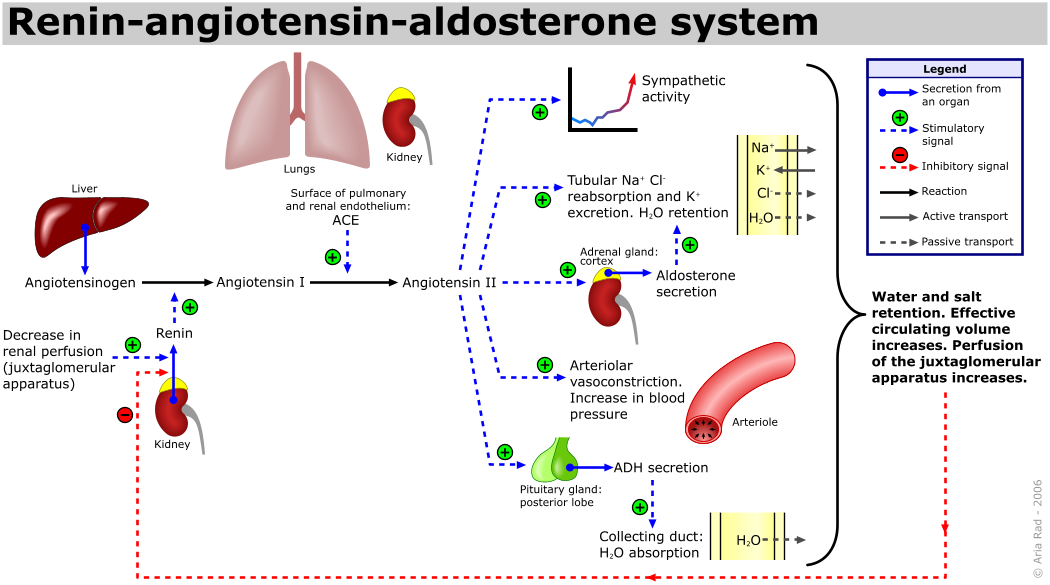
Note: the author's starting point on the diagram is a decrease in renal perfusion, but -- in his/her notes -- points out there are other ways RAAS can be activated -- "...by a low NaCl concentration in the macula densa or by sympathetic activation."
Be sure to scroll down for all the Nursing 7-related information. There are lots of other good posts by Trina and others, like Bonnie's links to information on hemodynamic basics or links to videos to refresh your clinical skills, next to the Starbucks IV bag below. Drink it up, y'all!
Wednesday, October 8, 2008
more shock

a. Manage fluid overload
b. Manage increased CO
c. Manage inadequate tissue perfusion
d. Manage vasoconstrxn of vascular beds
2. Which nursing assessment finding indicates hypovolemic shock in a pt who has had a 15% blood loss?
a. Pulse <> 30mL/hr
b. Systolic bP > 110
c. Diastolic > 90
d. RR of 20 braeths/min
4. which is a risk factor for hypovolemic shock?
a. Hemorrhage
b. Antigen antibody rxn
c. Gram neg bacteria
d. vasodilation
5. what is a priority assessment for the pt in shock who is receiving an IV infusion of PRBC and NS?
a. Fluid balance
b. Anaphylactic rxn
c. Pain
d. ALOC
6. the pt who does not respond adequately to fluid replacement has an order for an IV infusion of dopamine hydrochloride at 5u/kg/min. the desired fx of the drug is
a. increased renal and mesenteric BF
b. increased CO
c. vasoconstrx
d. reduced preload and afterload
7. A male pt who has been taking coumadin has been admitted c severe acute rectal bleeding and the following lab results: INR 8, Hmg 11, hematocrit 33%. Which MD orders would the nurse expect to implement initially? Select all that apply.
a. IV D5 ½ NS
b. Schedule pt for sigmoidoscoy in the AM
c. Give 1 unit FF plasma
d. Admin vitamin K 2.5 mg PO
e. Begin polyethylene glycol-electrolyte solution in preparation for signoidoscopy
f. Admin fleet’s enema
8. the nurse in perop holding area keeps a pt c gastric bleeding in a dimly lit environment c one family member present. What is the primary rationale for these nursing interventions?
a. Stabilize fluid and lyte balance
b. Minimize O2 consumption
c. Increase pt and family comfort
d. Prevent infxn
9. when assessing a pt for early septic shock, the nurse observes for which of the following?
a. Cool clammy skin
b. Warm flushed skin
c. Decreased systolic bp
d. hemorrhage
10. a pt c toxic shock has been receiving ceftriaxone sodium, in add’n to culture and sensitivity studies. What other lab finding does the nurse monitor?
a. Serum creat
b. Spinal fluid analysis
c. ABG
d. Serum osmolality
11. what intervention is most important in preventing septic shock?
a. Admin IV fluid replacement therapy as orderd
b. Obtaining VS q 4 hrs for all pts
c. Monitoring RBC counts for elevation
d. Maintaining asepsis of indwelling urinary catheters
12. which is a indication of a complication of septic shock?
a. Anaphylaxis
b. ARDS
c. COPD
d. Mitral valve prolapse
Sunday, October 5, 2008
Congenital Heart Defects

There are also some handy little animations of blood flow through various defects on our textbook's CD for chapter 48.